
Fluorescent to LED Conversion Guide (2026)
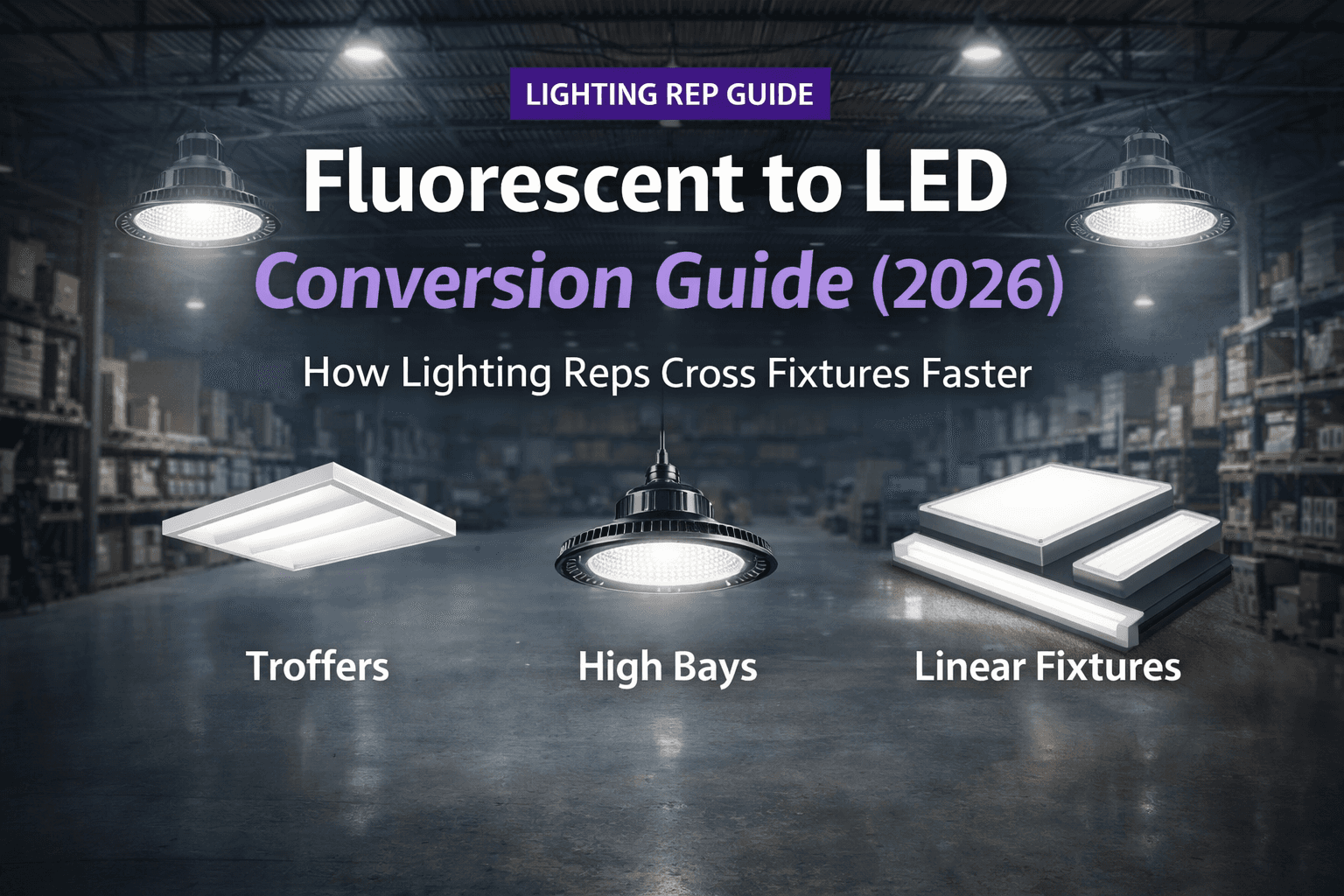
How Lighting Reps Cross Troffers, Panels, High Bays & Linear Fixtures Faster
Most lighting sales agencies don’t struggle with having the right LED fixtures. The real challenge is finding the right fixture quickly and efficiently.
After years of crossing fixtures manually for projects across offices, warehouses, and retrofit jobs, we’ve seen firsthand where the real bottlenecks occur.
Lighting product crossing has become one of the most critical—and time-consuming—processes in the industry, especially as demand continues to grow for LED upgrades, value engineering, and faster project turnaround. At its core, product crossing is the process of identifying equivalent or alternative fixtures that match key performance and design specifications, including:
Lumens
Wattage
Color temperature
Optics and distribution
Mounting type
Certifications and compliance requirements
This process commonly happens when rewiring fluorescent to LED, changing fluorescent ballasts, upgrading to energy-efficient LED tube lights, or replacing fluorescent lighting with LED systems. It also appears in larger applications such as:
Troffer replacements
Recessed LED fixtures
Removing can lights
High bay warehouse lighting
Pack lights
Hazardous location lighting
All of these applications are seeing increased demand as energy codes tighten and retrofit projects continue to grow across commercial buildings.
Quick Fluorescent to LED Conversion Examples
Below are a few common lighting conversion scenarios seen across commercial projects.
Office Retrofit
Existing Fixture:
2x4 Fluorescent Troffer
LED Replacement:
LED Panel (CPX / EPANL)
Why:
Lower maintenance, improved efficiency, and a cleaner architectural appearance.
Warehouse Conversion
Existing Fixture:
400W Metal Halide
LED Replacement:
LED High Bay
Why:
Significant energy savings with improved lumen output and distribution.
Back-of-House / Utility Spaces
Existing Fixture:
T8 Strip Fixture
LED Replacement:
CLS Linear Strip
Why:
Simple installation, cost-effective upgrade, and a direct functional replacement.
HID to LED Equivalency Guide
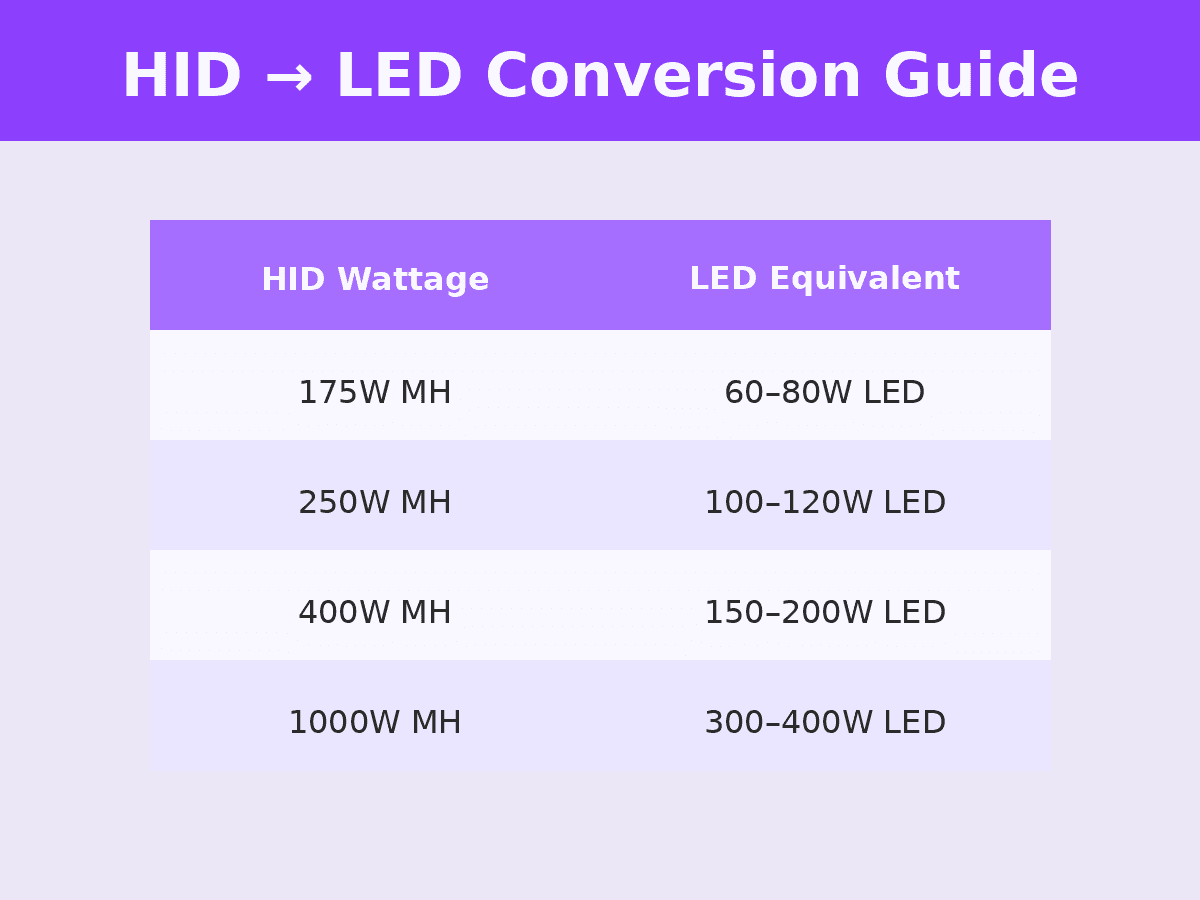
LED systems achieve comparable light output at significantly lower wattage, which is why these conversions are common in warehouses, industrial facilities, and distribution centers.
The Problem With Manual Product Crossing
Despite how important this process is, most lighting professionals still rely on manual workflows such as:
Digging through cut sheets
Comparing manufacturer PDFs
Maintaining internal spreadsheets
Relying on memory from past projects
Crossing a single fixture can take 10–40 minutes, and the process becomes exponentially more difficult when working through full fixture schedules.
Speed and accuracy matter. When reps are bidding projects against multiple agencies, the ability to produce accurate crosses quickly often determines whether a job is won or lost.
Why AI Is Changing Lighting Product Crossing
AI-powered lighting software is beginning to change how agencies approach this workflow.
Instead of manually comparing specs, AI tools analyze thousands of fixture attributes instantly, identifying equivalent products across a manufacturer’s line card in seconds rather than minutes.
Modern systems can also prioritize results based on:
Closest specification match
Pricing competitiveness
Manufacturer preferences
Product availability and lead times
This becomes particularly valuable when crossing commonly searched fixtures like Lithonia CPX or EPANL, where multiple equivalent options may exist across a line card.
AI tools also support broader workflows by helping teams evaluate lighting layouts using tools like recessed lighting calculators or referencing color temperature charts to ensure proper fixture selection.
Common Mistakes When Crossing Fixtures
Even experienced lighting professionals make these mistakes during conversions:
Choosing the wrong fixture type for the application
Matching wattage instead of lumens
Ignoring mounting or installation conditions
Overlooking color temperature requirements
Ignoring distribution patterns in high bays
Assuming all LED fixtures are interchangeable
Avoiding these mistakes requires both product knowledge and efficient workflows, which is why many agencies are beginning to automate parts of the crossing process.
The Real Bottleneck in Lighting Projects
The biggest challenge in fluorescent-to-LED conversions isn’t understanding LED technology.
It’s finding the right fixture fast enough.
Lighting reps spend a significant portion of their time searching through line cards, comparing specifications, and verifying compatibility across manufacturers. When working through large luminaire schedules, this manual process becomes a major bottleneck.
As retrofit demand increases and project timelines shrink, manual product crossing is quickly becoming a competitive disadvantage.
A New Approach to Lighting Workflows
Over the last few years, a new category of software has emerged to address these inefficiencies.
Lighting-specific AI platforms aim to automate core workflows such as:
Quote creation
Fixture schedule analysis
As someone working directly in the lighting rep industry, I’ve tested a number of lighting tools and internal workflows. Most solve part of the problem, but very few actually fix the entire process of crossing, quoting, and building submittals.
Our team has crossed thousands of fixtures across troffers, panels, linear systems, and high bays. When you’ve spent that many hours digging through spec sheets, you start to understand exactly where the bottlenecks are.
Luxion is being built with a different goal: to fix the workflow itself, not simply patch one step of the process.
Try Crossing Fixtures in Seconds
The fastest lighting reps today aren’t manually comparing spec sheets—they’re automating the workflow.
If you want to see what automated lighting workflows look like in practice, you can try Luxion to:
Cross fixtures instantly
Generate AI-powered submittals
Analyze entire luminaire schedules in seconds
Start a 14-day free trial and experience how much faster lighting workflows can be when product crossing happens automatically.
Author
Gianni Fontanna
Director of Sales & Customer Relations, Luxion
Lighting industry professional focused on product crossing, quoting workflows, and lighting project execution.